Saturday, 30 December 2017

CBSE Class 10 English Grammar - Determiners


Determiner:
‘Determiner’ is a word used before a norm to indicate which things or people we are talking about. The words ‘a’, ‘the’, ‘my’, ‘this’, ‘some’, ‘many’, etc. are called determiners:
  • He is a good boy.
  • The boy you met is my friend.
  • This novel is very interesting.
  • I have some information about the accident.
  • There were many people at the station.
All the italicised words are determiners and they limit the meaning of the nouns that follow them.


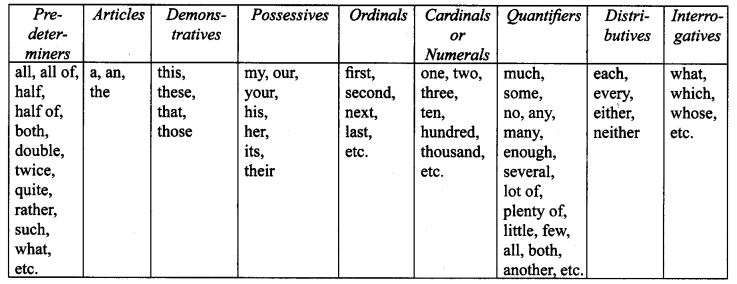
Kinds of Determiners:
197-7-2

CBSE CLASS 10 ENGLISH GRAMMAR - DETERMINERS


CBSE CLASS 10 ENGLISH GRAMMAR - DETERMINERS


Friday, 29 December 2017

CBSE Class 10 English Grammar - Clauses


Noun Clauses, Adverb Clauses of Time and Condition and Relative Clauses
1. clause is a group of words that includes a subject and a verb. It may be a sentence or the part of a sentence.
2. There are three kinds of clauses:
(i) Noun clause                                         (ii) Adverbial clause                  (iii) Relative clause.
3. Noun Clause:
Read the following sentences:
(a) I hope that I shall pass:.(noun clause)
(b) She knows what I want. (noun clause)
The underlined words are noun clauses and form parts of the sentences (a) and (b).
The noun clauses answer the question what?
The that-clause following the main clasue ‘I hope’ is also a noun clause just as ‘ What I want' is a noun clause which follows the main clause ‘she knows'.

Functions of Noun Clauses:
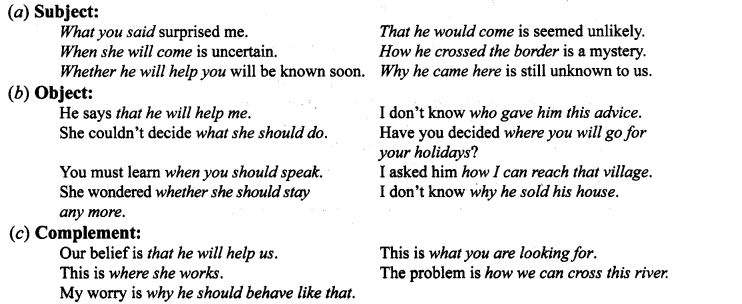
Noun clauses function like nouns or noun phrases. They can function as subject, object, complement, or object of a preposition, etc:
190-6-5


CBSE CLASS 10 ENGLISH GRAMMAR - CLAUSES


CBSE CLASS 10 ENGLISH GRAMMAR - CLAUSES


CBSE Class 10 English Grammar - Direct And Indirect Speech


(Statements, Commands, Requests and Questions)
The words spoken by a person can be reported in two ways—Direct and Indirect. When we quote the exact words spoken by a person, we call it Direct Speech.
  • Sohan said to Mohan, “I am going to school.”
The exact words spoken by Sohan are put within inverted commas. But when we give the substance of what Sohan said, it is called the Indirect Speech.
  • Sohan told to Mohan that he (Sohan) was going to school.

1. Reporting Clause and Reported Speech:
Sohan told Mohan that he was going to school. The words which generally come before the inverted commas are called the reporting clause

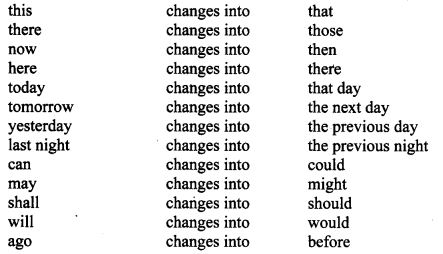
Changes in words expressing nearness, time, auxiliaries, etc.
184-5-4


CBSE CLASS 10 ENGLISH GRAMMAR - DIRECT AND INDIRECT SPEECH


CBSE CLASS 10 ENGLISH GRAMMAR - DIRECT AND INDIRECT SPEECH


CBSE Class 10 English Grammar - Subject-Verb Concord


A verb must agree with its Number and Person.
In other words, the Verb of a sentence agrees with Number and Person of the Subject of that sentence.
Error of Proximity
Often, the ‘Verb’ is made to agree in number with a norm near it instead of its proper Subject. It is an error. This common error is called the ‘Error of Proximity’. It should be avoided. The verb must agree with its proper Subject.
  1. The price of the apples was very high.                                                                                                                           (✓)
  2. The price of the apples were very high.                                                                                                                         (✗)

Number
The basic principle of Subject-Verb agreement is that singular subjects need singular verbs. Plural subjects need plural verbs:
181-1


CBSE CLASS 10 ENGLISH GRAMMAR - SUBJECT-VERB CONCORD


CBSE CLASS 10 ENGLISH GRAMMAR - SUBJECT-VERB CONCORD


CBSE Class 10 English Grammar - Active And Passive Voice


Voice:
Voice is that form of the transitive verb that shows whether the subject of the sentence is the doer of the action or has the action done to it. For example:
‘Mohan played football.’—This sentence is said to be in the active voice. Here, Mohan is the subject and he is the doer of the action, i.e. ‘played football’. The action of the subject is transferred to the object ‘football because Mohan has done something to the ‘football’. The passive voice of this sentence is:
Football was played by Mohan.
Here the subject is ‘football’ which was ‘object’ in the active sentence. So here something is done to the subject ‘football’, i.e. it suffers the action done by something or someone.

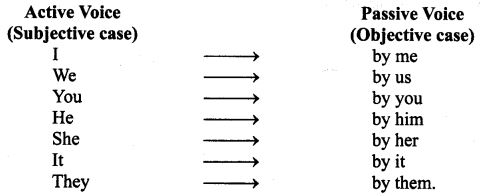
Changes in Pronous
177-3


CBSE Class 10 English Grammar - Modals


Modal auxiliaries are verbs such as can, must, could, would, etc. which are used with main verbs to express such ideas as possibility, permission, necessity, obligation, etc.
Characteristics of Modal Verbs
  1. The modal verbs are: (i) can (ii) could (iii) may (iv) might (v) must (vi) ought to (vii) shall (viii) should (ix) will (x) would (xi) dare (xii) need (xiii) have to (xiv) used to.
  2. Modal verbs have only one form. They have no ‘ing’ or ‘ed’ forms.
  3. They don’t add ‘s’ or ‘es’ to the third person singular form.
  4. For ex.: Mohan can speak two languages.                                        She will try and visit tomorrow.
  5. Modal verbs are followed by the infinitive of another verb without ‘to’ (first form of the verb).


CBSE CLASS 10 ENGLISH GRAMMAR - MODALS


CBSE CLASS 10 ENGLISH GRAMMAR - MODALS


CBSE Class 10 English Grammar - Tenses


I. How would you define the term ‘Tense’?
The term ‘Tense’ denotes the form of a verb which shows the time at which an action happened. So, the tense shows two things : (i) the time of the action (iii) state expressed by the verb.
Look at these sentences:
  • Reshma goes to school.
  • Reshma went to school.
  • Reshma will go to school.


1-163-1


CBSE CLASS 10 ENGLISH GRAMMAR - TENSES


CBSE CLASS 10 ENGLISH GRAMMAR - TENSES